

Across sub-Saharan Africa, many learners in early grades struggle with basic numeracy, despite investments in textbooks and teacher training. Traditional instruction often focuses on correctness over comprehension, leaving errors unaddressed or misunderstood. But what if these very mistakes held the key to learning? A recent pilot across Kenya, Nigeria, and South Africa embraced this philosophy, training teachers to treat learner errors as diagnostic tools. The result? Improved learning, more engaged classrooms, and re-energized teachers.
Methodology
The pilot used a mixed-methods design and was implemented over 5–6 months in 14 schools. It targeted Grade 2 and 3 teachers and learners, using:
- Quantitative: ICAN assessments, teacher audits, and learner engagement checklists.
- Qualitative: Classroom observations and interviews.
- Design: Intervention versus control in Nigeria and South Africa; Kenya implemented only the intervention.
Teachers received training on using error logs to identify conceptual, factual, and procedural errors and adjust instruction accordingly. Periodic coaching supported implementation.
Results
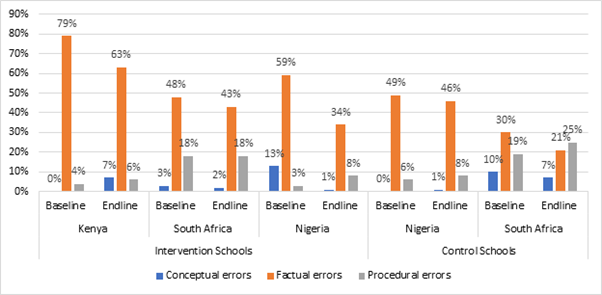
Evidence from the pilot across Kenya, Nigeria, and South Africa reveals that integrating error analysis and formative assessment into daily teaching can significantly enhance classroom instruction and learner achievement in early numeracy. The results show varied observable errors (by type), including notable improvements by country, indicating that with the right training, tools, and sustained support, these instructional methods can effectively address foundational math learning challenges. Table 1 below highlights results derived from the pilot by error type.
Table 1: Type of Error by Country – Intervention versus control1
Nigeria: A Strong Success Story
Nigeria’s results were the most impressive. Schools that received the intervention cut conceptual errors (confusions about the “why” behind math) from 13% to just 1%, and correct answers jumped from 26% to 55%. This shows that learners really started to understand what they were doing. However, procedural errors (trouble with applying steps) went up slightly from 3% to 8%, suggesting learners may need more practice with applying their new knowledge to real problems.
South Africa: Mixed Signals
South Africa’s results were less encouraging. Factual errors only dropped slightly from 48% to 43%, and procedural and conceptual errors barely changed. Interestingly, control schools (those that didn’t receive the intervention) performed better in some areas, for example, reducing factual errors from 30% to 21% and increasing correct answers from 41% to 49%. This raises important questions about how the intervention was implemented in South Africa.
Kenya: Promising, but with some gaps
Kenya showed encouraging progress in some areas. Factual errors went down from 79% to 63%, and correct responses soared from 12% to 43%. This shows learners were improving in basic understanding. But there were new concerns: conceptual errors appeared (0% to 7%), and procedural errors rose slightly (4% to 6%), possibly suggesting that learners were improving at memorizing steps but not fully understanding the concepts behind them.
Interpretation and Implications
These results show that improving early numeracy is possible—but success depends on how the program is designed and delivered.
- Nigeria’s success suggests that when teachers get ongoing coaching and use structured tools, they can help learners make real progress in understanding math.
- Kenya’s gains in factual knowledge are encouraging, but the rise in conceptual errors hints that rote learning may be crowding out deeper thinking.
- South Africa’s minimal progress highlights a need for better follow-up and stronger implementation strategies. It also shows that just introducing a new method is not enough, it must be well supported.
Across the board, the results suggest that reducing conceptual errors is most closely tied to improving overall math performance. When learners understand why math works the way it does, they’re more likely to get the right answers.
Recommendations
Based on the results, below are four key actions that education policymakers, school leaders, and development partners can take:
- Strengthen Teacher Support Through Coaching.
- Nigeria’s success shows the power of ongoing coaching. Regular support helps teachers make sense of student errors and respond effectively.
- Education ministries should train district-level coaches and create peer-learning groups for continuous improvement.
- Focus on Conceptual Understanding, Not Just Procedures.
- Kenya’s and South Africa’s results remind us that it’s not enough to teach learners how to solve problems—they need to know why the solution works.
- Materials and teacher guides should include strategies for building conceptual clarity, such as using visual aids, number talks, and real-life examples.
- Customize Implementation to Local Contexts.
- The differences across the three countries show there’s no one-size-fits-all approach.
- Interventions must be adapted to local realities—including classroom size, language of instruction, and teacher capacity—to succeed.
4. Use Error Patterns to Guide Teaching